
Giới thiệu
As beauty technology continues to evolve, the European market has seen rapid growth in both home use beauty devices and professional salon beauty devices. For buyers such as distributors, importers, private-label brands, and salon chains, a common sourcing question arises:
Should we focus on home-use beauty devices or salon-use beauty devices?
The answer depends on market positioning, target customers, budget, and long-term brand strategy. This article provides a clear comparison between home use vs salon beauty devices, helping buyers choose the right product direction and sourcing model for the European market.
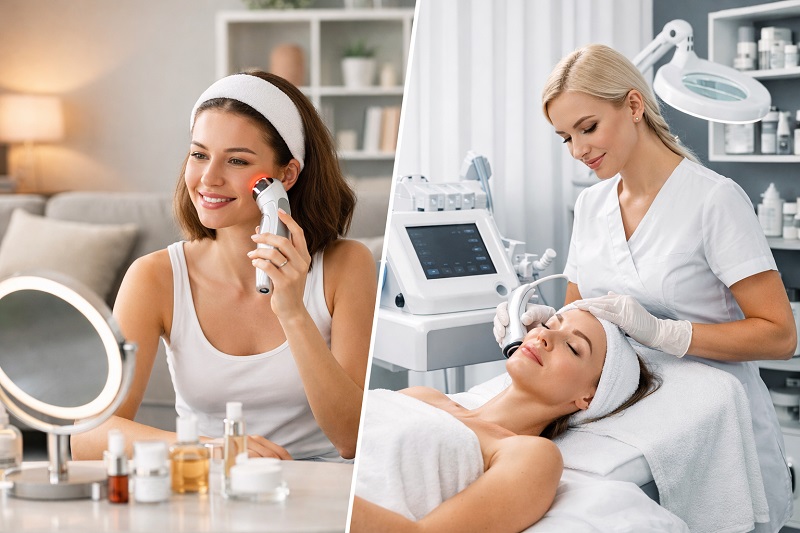
Understanding Home Use Beauty Devices
What Are Home Use Beauty Devices?
Home use beauty devices are designed for individual consumers to perform skincare treatments safely at home. These devices offer simplified operation, controlled energy output, and compact designs while delivering visible skincare benefits.
Common home-use categories include:
- RF facial tightening devices
- LED light therapy beauty devices
- Microcurrent facial lifting devices
- Anti-aging and wrinkle reduction devices
- Acne treatment and skin cleansing devices
Key Characteristics of Home Use Beauty Devices
- Lower energy output for safety
- Easy-to-use controls
- Compact and portable design
- Rechargeable or cordless operation
- Clear user instructions and safety warnings
In Europe, CE certification is mandatory for all home-use beauty devices, making compliance a core purchasing factor.
Understanding Salon Beauty Devices
What Are Salon Beauty Devices?
Salon beauty devices are professional-grade machines used in beauty salons, spas, and aesthetic clinics. These devices are operated by trained professionals and are designed for higher intensity, longer usage, and consistent performance.
Typical salon-use devices include:
- Professional RF and EMS machines
- Multi-function facial treatment devices
- Skin rejuvenation and lifting systems
- Advanced anti-aging beauty equipment
Key Characteristics of Salon Beauty Devices
- Higher power and performance levels
- Durable construction for frequent use
- Larger size and more advanced interfaces
- Customizable treatment parameters
- Longer service life
Salon beauty devices usually require additional safety testing and documentation, especially for the European market.
Home Use vs Salon Beauty Devices: Key Differences
| Aspect | Home Use Beauty Devices | Salon Beauty Devices |
|---|---|---|
| Target User | Individual consumers | Professionals |
| Power Level | Low, safety-focused | Higher, professional-grade |
| Design | Compact, portable | Larger, durable |
| Ease of Use | Simple, intuitive | Requires training |
| Chứng nhận | CE mandatory | CE + advanced compliance |
| Price Range | Medium to high retail margins | Higher unit price |
| Sales Channel | Retail, e-commerce | B2B, salons, clinics |
This comparison highlights how each product type serves a different business model.
Market Demand in Europe: Home Use vs Salon
Strong Growth of Home Use Beauty Devices
European consumers increasingly invest in at-home skincare solutions due to:
- Convenience and time savings
- Rising awareness of beauty technology
- Demand for non-invasive treatments
This trend makes home-use beauty devices ideal for:
- E-commerce brands
- Retail chains
- Direct-to-consumer (DTC) models
Stable Demand for Salon Beauty Devices
Despite home-use growth, professional salons and clinics remain essential in Europe. Salon owners continue to invest in advanced devices to:
- Differentiate services
- Increase treatment value
- Retain loyal customers
Salon beauty devices are well-suited for:
- Distributors
- Professional equipment suppliers
- Salon chains and clinics
OEM & ODM Considerations for Buyers
OEM Home Use Beauty Devices
OEM manufacturing is especially popular for home-use devices. Buyers can:
- Apply their own branding
- Customize packaging and manuals
- Launch products quickly
- Reduce development costs
OEM home-use beauty devices are ideal for brands testing the European market.
ODM Salon Beauty Devices
Salon beauty devices often benefit from ODM development, allowing deeper customization such as:
- Functional parameter adjustment
- Multi-function system integration
- Custom interface design
- Professional treatment modes
ODM solutions help professional buyers build exclusive, high-value equipment lines.
Which Should Buyers Choose?
Choose Home Use Beauty Devices If You:
- Target retail or online consumers
- Want faster market entry
- Prefer lower MOQ and lighter logistics
- Focus on branding and marketing
Home-use devices offer scalability and faster sales cycles.
Choose Salon Beauty Devices If You:
- Serve professional salons or clinics
- Aim for higher unit prices
- Focus on long-term B2B relationships
- Have technical support capabilities
Salon devices build stronger professional credibility and long-term contracts.
A Hybrid Strategy: The Best of Both Worlds
Many European buyers adopt a dual-product strategy, offering:
- Home-use devices for consumer sales
- Salon-use devices for professional channels
This approach maximizes market coverage and brand influence.
Choosing the Right Beauty Device Manufacturer
Regardless of product type, buyers should work with a manufacturer that offers:
- OEM & ODM capabilities
- Strong R&D and production capacity
- CE compliance experience
- Stable quality control
- Flexible MOQ and scalable production
Direct cooperation with a professional factory ensures cost efficiency, product reliability, and long-term success.
Phần kết luận
There is no single correct answer to home use vs salon beauty devices—the best choice depends on your target market and business strategy.
- Home-use beauty devices offer fast growth and strong consumer demand
- Salon beauty devices provide professional positioning and higher value
By understanding these differences and partnering with the right OEM/ODM manufacturer, buyers can confidently develop competitive beauty device product lines for the European market.